What Is the Difference Between Tyre Patching and Plugging?
Patching seals your tyre from the inside with a rubber patch; plugging jams a rubber stem through the hole from outside. One lasts, one is a gamble.
Tyre patching seals a puncture from the inside of the tyre with a bonded rubber patch, while plugging pushes a rubber stem through the hole from the outside without removing the tyre. Patching is the permanent, industry-approved repair; plugging is a quick roadside fix that can fail under heat and load. If you drive in Al Ain, where summer asphalt regularly hits 60°C and above, that difference decides whether your tyre holds for years or lets go on the E22 at 120 km/h.
Below we break down how each method works, what they cost in Al Ain in 2026, which one actually lasts, and the mistakes we fix every week at our workshop.
The Short Answer: Patch vs Plug Tyre Repair in Al Ain
Tyre patching vs plugging in Al Ain comes down to one thing: a patch is glued to the inner liner of the tyre, so air pressure pushes it tighter against the hole, while a plug relies on friction and rubber compression from the outside. A patch is a repair. A plug is a plug.
Here is the practical breakdown:
- Patching: tyre removed from the rim, hole cleaned and buffed, patch bonded from inside, tyre rebalanced and refitted. Takes 25-40 minutes. Lasts the life of the tyre when done properly.
- Plugging: tyre stays on the car, a rubber stem is forced through the puncture with a reaming tool. Takes 5-10 minutes. Holds for weeks or months, not years.
- Best practice: a patch-and-plug combination (often called a mushroom repair) from the inside, which fills the hole and seals the liner at the same time.
For most drivers, the answer is simple: patch if you want it fixed once. Plug only if you need to limp to a workshop. If you want the job done properly the first time, our tyre puncture repair in Al Ain uses the patch-and-plug method on every repairable puncture.
How Tyre Patching Works (and Why It Seals Properly)
Tyre patching Al Ain drivers can rely on follows a fixed sequence that leaves no room for shortcuts. We take the wheel off, break the bead, and pull the tyre from the rim so we can see the inside of the casing.
From there the process is:
- Locate the puncture from both sides and mark it.
- Ream the injury channel to remove debris, glass, or grit.
- Buff the inner liner around the hole so the patch adhesive can grip.
- Apply vulcanising cement and let it flash off.
- Press a rubber patch (or mushroom plug) firmly onto the liner, working out air bubbles.
- Refit the tyre, seat the bead, inflate to the vehicle's placard pressure, and rebalance the wheel.
The whole job runs 25-40 minutes per tyre. The patch becomes part of the tyre's structure - it is chemically bonded, not just pressed in. That is why a properly patched tyre holds its pressure through Al Ain's summer and through the temperature swings we get from October onwards, when mornings sit around 22°C and afternoons still push past 38°C.
Patching only works if the puncture sits in the repairable crown area - roughly the central 70% of the tread. Sidewall damage cannot be patched. Neither can a puncture larger than 6 mm, or one where the tyre has been run flat and the inner liner is scorched. In those cases we replace the tyre, and we tell you straight rather than sell you a repair that will not hold.
How Tyre Plugging Works (and Where It Falls Short)
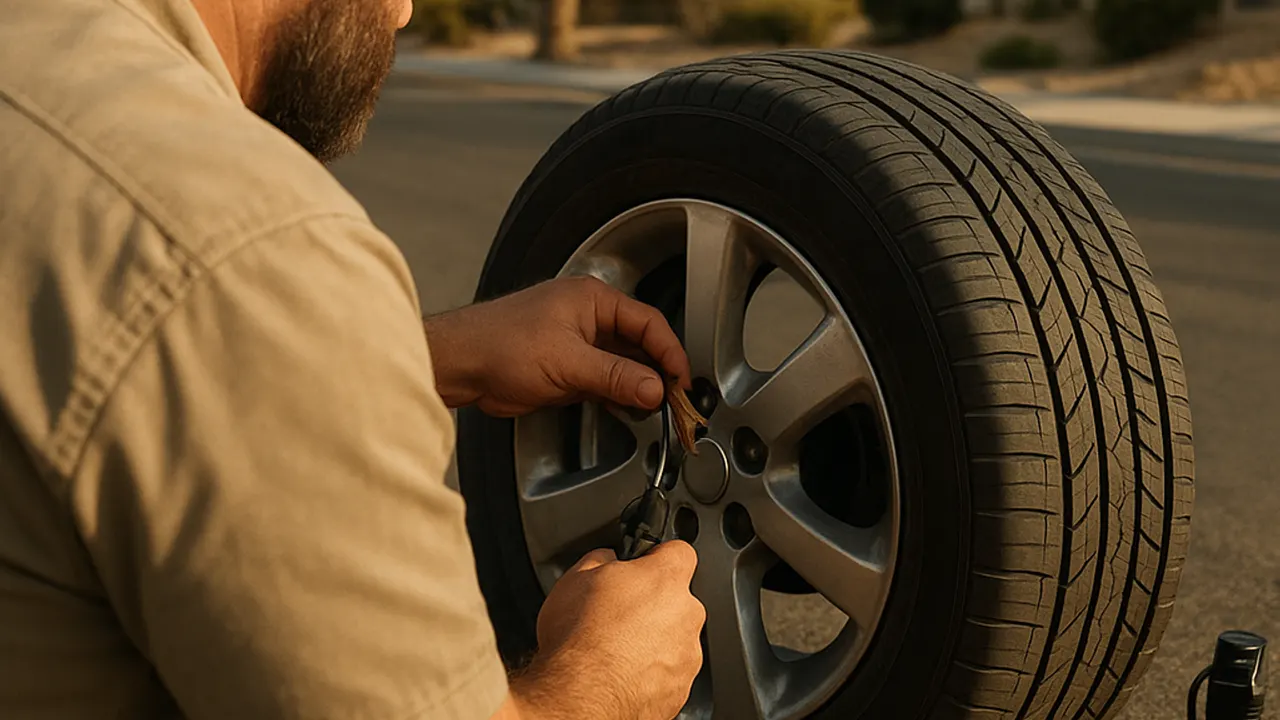
Tyre plugging Al Ain motorists ask about is the roadside method: you keep the tyre on the car, find the nail, pull it, and force a rubber plug through the hole with a T-handle tool. The plug is coated in cement and expands to fill the channel.
It works. For a while.
The problem is what the plug does not do. It does not seal the inner liner, so air can still migrate between the tyre's layers. It does not bond chemically to the casing. And it leaves the injury channel open to water and grit, which is a real issue in Al Ain where dust gets into everything. Over a few thousand kilometres, the plug starts to work loose, especially on the rear tyres of a loaded SUV running 40 psi in 45°C heat.
We see plugged tyres come in with slow leaks every week. Usually the driver topped up the air twice before giving up. By then the plug has often damaged the liner enough that a proper patch is no longer an option.
There is one legitimate use for a plug: getting you off the roadside and to a workshop. If you are stuck near Al Jimi tyre repair Al Ain territory on a Friday evening, a plug can get you home. It is not a fix. It is a tow truck you can drive.
Which Is Better, Tyre Patching or Plugging in Al Ain?
Patching is better in Al Ain for every puncture that qualifies for repair, because it is the only method that seals the tyre from the inside and survives our heat cycle. Plugging is only better when you have no other option and need to move the car now.
Here is how the two compare on the things that matter:
- Lifespan: patch - life of the tyre; plug - weeks to a few months.
- Safety at highway speed: patch - rated for full speed; plug - not rated for sustained high speed.
- Heat resistance: patch - bonded rubber, stable past 70°C; plug - softens and can migrate.
- Cost: patch - AED 40-80; plug - AED 20-40.
- Time off the road: patch - 25-40 minutes; plug - 5-10 minutes.
If you are searching for the best tyre repair method in Al Ain, the honest answer is: the one that removes the tyre and seals it from the inside. Anything that skips that step is a temporary measure.
We also see drivers asking about this after a puncture on the Al Ain-Dubai road or on the truck route out towards Hili. High-speed, high-heat driving is exactly where a plug is most likely to let go. If your commute runs that way, do not gamble on a plug.
Tyre Patching vs Plugging Cost in Al Ain (2026 Prices)
Tyre patching vs plugging cost in Al Ain sits in a narrow band, and the gap is smaller than most drivers expect. Typical 2026 pricing at a proper workshop:
- Plug repair (roadside or quick-stop): AED 20-40 per tyre.
- Standard patch repair: AED 40-60 per tyre.
- Patch-and-plug (mushroom) repair with rebalance: AED 60-80 per tyre.
- Mobile call-out to your location in Al Ain: add AED 30-60 depending on distance.
Compare that to a new tyre at AED 250-900 depending on size and brand, and the maths is obvious. A AED 60 patch that saves a AED 500 tyre is the cheapest motoring decision you will make this year.
What you should avoid is paying twice. A AED 30 plug that fails in six weeks and forces a AED 60 patch later costs AED 90 and two trips. We would rather do it once.
If your tyre is losing air but you cannot see a nail, the problem may not be a puncture at all. Valve stems, bead leaks, and corroded rims cause slow pressure loss that no patch will fix. That is a different job - our car tyre leak repair in Al Ain covers those cases, and we pressure-test the whole assembly before we hand the car back.
Is Tyre Plugging Safe in Al Ain? What the Heat Does to Plugs
Is tyre plugging safe in Al Ain? For low-speed driving to a workshop, yes. For sustained highway driving in summer, no - and the reason is temperature.
A tyre running at 100 km/h on a 48°C day in Al Ain sees tread temperatures well past 70°C. Rubber plugs are designed to compress and seal at ambient temperatures, not at those numbers. Under that heat, the plug softens, the cement bond weakens, and centrifugal force at speed starts working the plug outwards.
We have pulled plugs out of tyres by hand - no tools - after a few months of summer driving. That is not a repair. That is a countdown.
There is also the pressure question. Most Al Ain SUVs and 4x4s run 35-42 psi. A plug that holds at 32 psi may weep at 40 psi. If you have plugged a tyre and you are topping up air more than once a month, the plug is already failing.
One more thing: plugs are not a permanent repair under any recognised tyre industry standard. They are a temporary measure. Treat them that way.
Common Mistakes We See on Al Ain Roads
The mistakes we fix most often in Al Ain all come from treating a plug as a finished repair. Here are the ones that cost drivers real money:
- Plugging a sidewall puncture. Sidewalls flex constantly. A plug there will fail, and the tyre is scrap anyway - sidewall damage is never repairable.
- Plugging a puncture bigger than 6 mm. The plug cannot fill the channel. Air escapes around it from day one.
- Plugging a tyre that was run flat. Once the inner liner is heat-damaged, no patch or plug will bond to it. The tyre is done.
- Plugging two punctures close together. Repairs need spacing. Two holes within 40 cm of each other usually mean replacement.
- Skipping the rebalance. Any repair that adds or removes material from the tyre changes its balance. Ignore that and you get a vibration at 100 km/h that chews your suspension bushes.
- Not checking the spare. Half the cars we see in Al Ain have a spare at 15 psi. Check it before you need it.
None of these are exotic. They are the everyday result of a five-minute plug being asked to do a forty-minute job.
When to Call a Professional
Call a professional when the puncture is in the tread, the tyre is still holding some air, and you want it fixed once. That is the job we do every day.
Bring the car to us, or we come to you. Our team covers Al Ain city and the surrounding districts, and we carry patch kits, mushroom plugs, balancing equipment, and a compressor in the van. If the tyre cannot be repaired, we tell you before we touch it - no charge for the assessment.
If you are not sure whether your puncture is repairable, send us a photo of the tread and the sidewall. We will tell you straight whether it is a patch job or a replacement. That saves you a wasted trip and, more importantly, saves you from driving on a repair that was never going to hold.
For drivers who would rather not move the car at all, our tyre repair at home in Al Ain service brings the workshop to your driveway or office car park. Same patch-and-plug method, same equipment, same result.
Frequently Asked Questions
What is the difference between tyre patching and plugging in Al Ain?
Patching seals the puncture from inside the tyre with a bonded rubber patch after the tyre is removed from the rim. Plugging pushes a rubber stem through the hole from outside without removing the tyre. Patching is permanent; plugging is a temporary fix that lasts weeks to months.
Is tyre plugging or patching better in Al Ain?
Patching is better for any repairable puncture in Al Ain. It survives the 60°C-plus road temperatures that cause plugs to soften and migrate. Use a plug only to reach a workshop, then have it patched properly within a few days.
Can I use a tyre plug kit in Al Ain?
You can use a plug kit to get off the roadside, but it is not a permanent repair. In Al Ain's summer heat, a plug can work loose within a few thousand kilometres. Have it replaced with a proper patch as soon as you can reach a workshop.
Which tyre repair method lasts longer in Al Ain?
A patch-and-plug (mushroom) repair done from inside the tyre lasts the life of the tread, typically 40,000-60,000 km. A standard plug lasts weeks to a few months in Al Ain conditions. The cost difference is AED 20-40, and the patch is the better value every time.
How much does tyre patching vs plugging cost in Al Ain?
In 2026, a plug repair runs AED 20-40 and a proper patch repair AED 40-80, including rebalancing. Mobile call-out adds AED 30-60. Both are far cheaper than a replacement tyre at AED 250-900.
Get Help with Tyre Repair Al Ain in Al Ain
If your tyre is losing air and you want it fixed properly the first time, call Al Ain Tyre Rescue. We patch, plug, balance, and pressure-test on site, and we tell you honestly when a tyre is beyond repair.
Call us on 971 50 757 1372 and we will get you back on the road today.